
CAMPUS & FACILITIES
A Learning Environment Designed for Future Educators
At Sushant Teacher’s Training College, we believe that an effective learning environment plays an important role in preparing confident and competent educators.
Our campus at Nunfara, Muzaffarpur provides academic, instructional and technology-enabled facilities designed to support classroom learning, practical training, creativity and the overall professional development of our students.
4-Acre Green Campus | 400+ Trees | Modern Classrooms | Laboratories | Library | ICT Facilities
A Campus Designed for Learning

Where Education Meets Environment
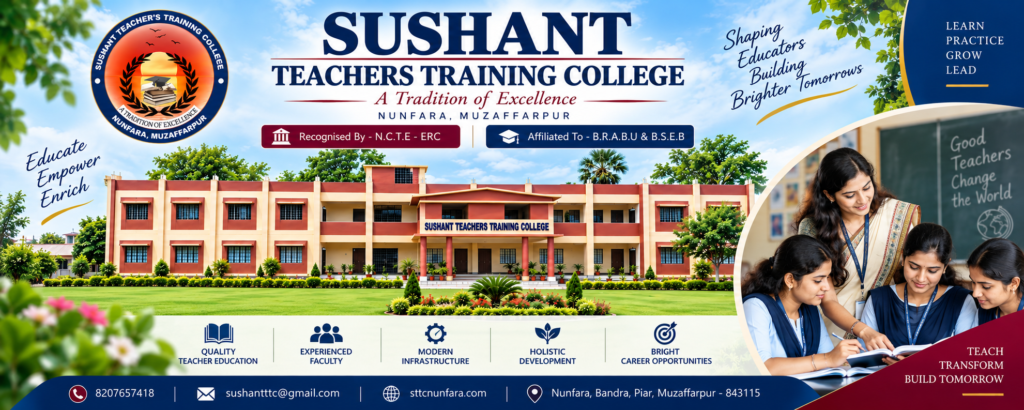
Sushant Teacher’s Training College is situated on a 4-acre lush-green campus at Nunfara, Muzaffarpur.
The peaceful campus provides students with an environment conducive to learning, interaction, creativity and professional development.
The institution has made conscious efforts towards maintaining a green and environmentally responsible campus through:
400+ Trees
More than 400 trees contribute to the green character and natural environment of the campus.
Water Conservation
A central water-conservation system supports responsible utilisation and management of water resources.
Landscaped Green Areas
Well-developed gardens and green spaces create a pleasant environment for students and staff.
Tree Conservation
The institution encourages the protection and preservation of trees and greenery across the campus.
We believe that an educational campus should not merely contain classrooms — it should create an environment that encourages students to learn, think, interact and grow.
Instructional Facilities
Modern Spaces for Effective Teaching & Learning
Teacher education requires interaction, discussion, demonstration, collaboration and practical learning.
The institution therefore provides a range of instructional spaces designed to support different teaching-learning activities.
Spacious Classrooms
Comfortable Spaces for Interactive Learning
The college provides student-friendly classrooms designed to facilitate effective teaching and active participation.
Classroom teaching incorporates appropriate educational and audio-visual resources to make the learning process more engaging and interactive.
The classrooms support:
• Regular Academic Teaching
• Interactive Lectures
• Student Presentations
• Group Discussions
• Teaching Demonstrations
• Collaborative Learning
• Audio-Visual Learning
The aim is to create a classroom environment where future teachers experience the same interactive and learner-centred approaches that they can later apply in their own professional practice.
Tutorial Rooms
Learning Through Interaction
Tutorial rooms provide an environment for smaller-group academic interaction.
They are particularly useful for:
• Small-Group Discussions
• Tutorials
• Academic Guidance
• Student Presentations
• Collaborative Activities
• Doubt-Clearing Sessions
Smaller learning groups allow students to communicate more freely, participate actively and receive focused academic guidance.
Seminar Hall
A Platform for Ideas, Interaction & Professional Growth
The seminar hall provides a dedicated space for academic and professional-development activities.
It can be used for:
Seminars • Workshops • Guest Lectures • Presentations • Orientation Programmes • Group Activities • Academic Events • Cultural Programmes
Such activities expose prospective teachers to learning experiences beyond routine classroom instruction and help strengthen their communication, confidence, leadership and presentation skills.
Activity Room
Creativity is an Essential Part of Teaching
Teaching is not limited to textbooks and lectures.
The Activity Room provides students with opportunities to participate in creative, collaborative and educational activities that complement their professional training.
Activities may include:
• Art & Craft
• Teaching-Learning Material Preparation
• Creative Activities
• Group Work
• Educational Demonstrations
• Co-Curricular Activities
• Practice-Based Learning
Such experiences encourage future educators to explore creative approaches that can make classroom teaching more engaging and learner-friendly.
Laboratories
Learning Through Exploration & Practice
Practical experience is an important component of teacher education.
The institution provides laboratory facilities that allow prospective teachers to connect theoretical concepts with observation, experimentation, demonstration and technology-enabled learning.
Science Laboratory
Explore • Experiment • Understand
The Science Laboratory provides resources for practical and demonstration-based learning in different areas of science.
The laboratory contains equipment and educational materials relevant to science teaching, including resources for:

Physics
Chemistry
Biological Sciences
Available teaching and experimental resources include laboratory tables, weighing equipment, resistance-related apparatus, prisms, Newton’s ring apparatus, polarimeter-related equipment, biological models and other educational materials.
For prospective teachers, the laboratory is particularly important because it provides opportunities not only to understand scientific concepts but also to learn how those concepts can be demonstrated effectively to school students.
Learning Science by Doing
Practical experience helps future teachers develop:
Observation Skills
Experimental Understanding
Scientific Temperament
Demonstration Skills
Ability to Explain Concepts Practically
Computer & Multimedia Laboratory

Preparing Teachers for the Digital Classroom
Technology has become an important part of contemporary education.
The Computer & Multimedia Laboratory provides students with opportunities to develop familiarity with information and communication technology and its application in teaching and learning.
The facility includes computer systems and multimedia resources that support technology-enabled educational activities.
Students can use the laboratory to develop skills in:
• Basic Computer Applications
• Digital Educational Resources
• ICT-Based Teaching
• Multimedia Presentations
• Preparation of Digital Teaching Materials
• Educational Content & Research
• Technology-Assisted Learning
ICT in Teacher Education
Technology as a Teaching Tool
For today’s educator, digital literacy is increasingly important.
Our approach is therefore not simply to introduce students to computers, but to encourage them to understand how technology can be meaningfully incorporated into the teaching-learning process.
Prospective teachers are encouraged to become comfortable using digital resources for:
Lesson Preparation
Classroom Presentations
Educational Research
Teaching-Learning Materials
Information Access
Professional Development
This helps prepare students for increasingly technology-enabled classrooms and educational environments.
Library & Learning Resource Centre

Knowledge Beyond the Classroom
The College Library is an important academic resource for students and faculty.
It provides a learning environment where students can supplement classroom teaching through independent reading, reference work and academic study.
The library contains books and learning resources covering various areas related to teacher education and academic disciplines.
Resources support areas such as:
Education & Pedagogy
Psychology & Child Development
Teaching Methodology
School Subjects
Language & Literature
Educational Technology
General Knowledge & Reference
Professional Teacher Education
Adequate seating arrangements provide students with a comfortable environment for reading and academic work.
Why the Library Matters
Read • Reflect • Research • Grow
For a future teacher, reading is not simply an academic requirement.
Regular engagement with books and educational resources helps prospective educators develop:
Broader Knowledge
Critical Thinking
Language & Communication Skills
Professional Understanding
Independent Learning Habits
Research Orientation
Students are encouraged to make the library an active part of their academic journey.
Teaching-Learning Resources
Tools That Help Future Teachers Teach Better
Teacher education involves learning not only what to teach, but also how to teach effectively.
Students are encouraged to develop and use different teaching-learning resources as part of their professional preparation.
These may include:
Charts & Models
Educational Displays
Subject-Based Teaching Aids
Activity-Based Learning Materials
Audio-Visual Resources
Digital Presentations
ICT-Based Teaching Materials
Creating and using these resources helps prospective teachers learn how complex ideas can be presented in ways that are clearer, more engaging and appropriate for different learners.
Practical Learning Environment
From Theory to Teaching Practice
Our facilities are designed to complement the practical nature of professional teacher education.
Throughout their academic journey, students receive opportunities to participate in:
Teaching Demonstrations
Lesson Planning
Micro-Teaching Activities
Practical Assignments
Presentations
Group Activities
Workshops & Seminars
ICT-Based Learning
School-Based Experiences
Teaching Practice & Internship
These experiences help bridge the gap between educational theory and real classroom practice.
Green Campus
Learning in Harmony with Nature
One of the distinctive features of Sushant Teacher’s Training College is its green campus environment.
Spread across approximately 4 acres, the campus contains more than 400 trees, landscaped areas and systems supporting water and tree conservation.
The green surroundings provide students with a peaceful atmosphere while also reinforcing awareness of environmental responsibility and sustainable living.
For future educators, environmental awareness is particularly important because teachers themselves play a role in developing environmentally responsible attitudes among future generations.
More Than Infrastructure
Facilities with an Educational Purpose
For us, infrastructure is valuable only when it contributes meaningfully to student learning.
A classroom should encourage interaction.
A laboratory should encourage curiosity.
A library should encourage reading.
A computer laboratory should encourage innovation.
An activity room should encourage creativity.
And a campus should provide an environment where students feel inspired to learn.
This philosophy guides the development and use of facilities at Sushant Teacher’s Training College.
Campus at a Glance
4 Acres
Green Campus
400+
Trees on Campus
Academic Spaces
Classrooms & Tutorial Rooms
Professional Learning
Seminar & Activity Facilities
Practical Education
Science Laboratory
Digital Learning
Computer & Multimedia Laboratory
Knowledge Resources
College Library
Sustainable Campus
Water & Tree Conservation
Explore Our Campus
Take a Closer Look at Life at STTC
Experience the academic environment, infrastructure and facilities of Sushant Teacher’s Training College through our campus gallery.